Every jet/vac and CCTV crew opens manholes daily. The cover ring at the opening is one of the most foundational pieces of equipment on the job, and yet it is also one of the least carefully evaluated. “Cover ring” covers a wide spectrum, from $200 plastic edge protectors to integrated manhole protection ring systems north of $3,000. The differences are not cosmetic. The wrong ring costs time, equipment, and exposure across hundreds of touchpoints per year.
This guide is built for crews running jet trucks, vac trucks, combo trucks, and CCTV inspection rigs. It walks through what actually matters when you are picking a manhole cover ring for these specific operations, the criteria that separate a passive marker from a tool that earns its keep, and how to make the case internally when the price tag triggers a budget conversation.
The short answer:
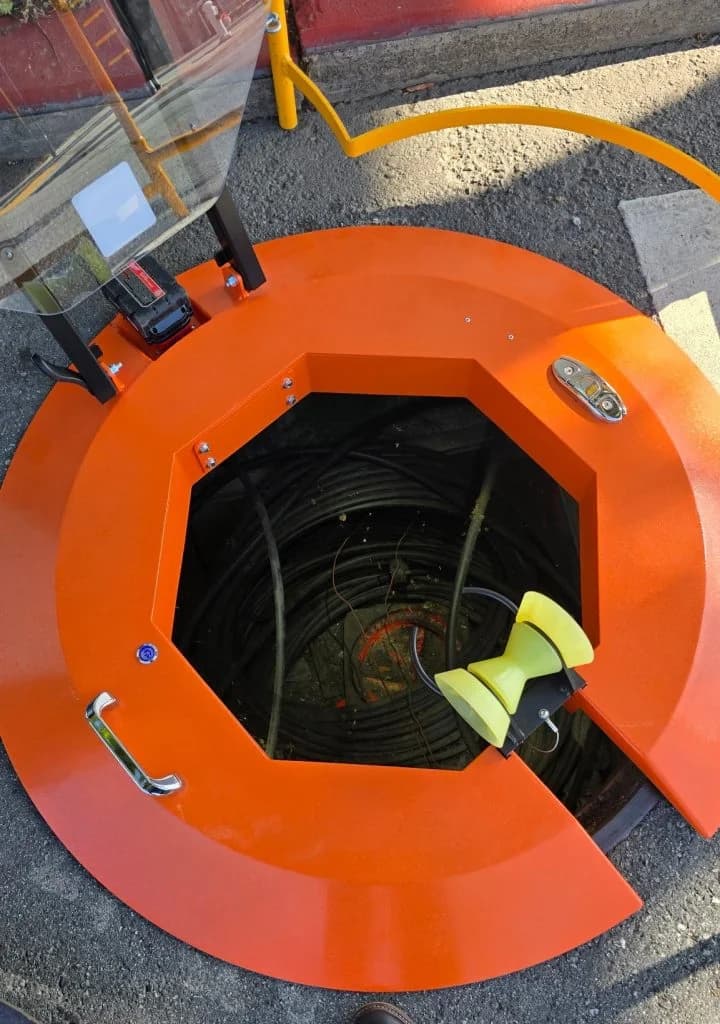
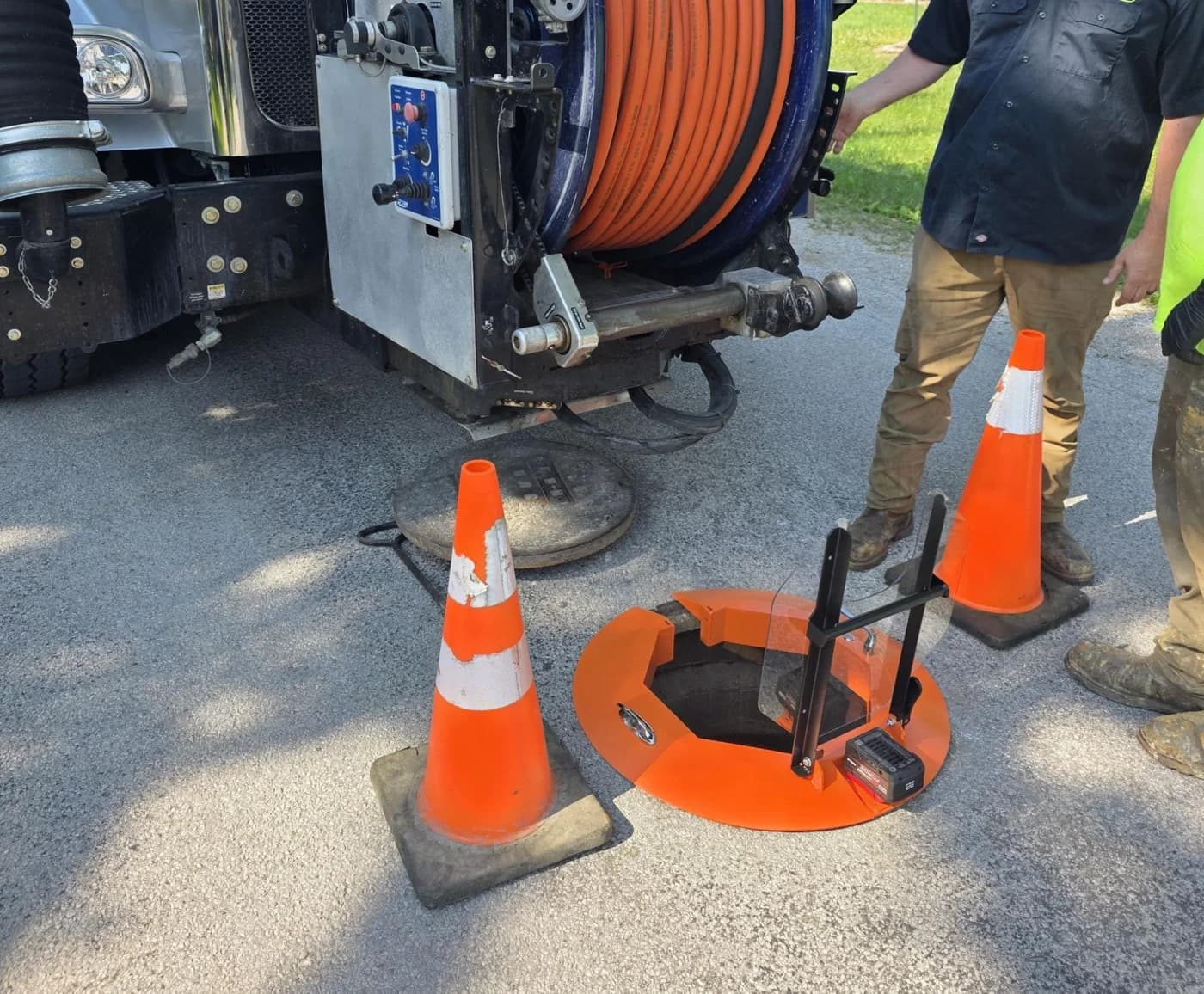
The best manhole cover ring for jet truck and CCTV crews is an integrated illuminated system that combines a structural aluminum barrier, high-output LED lighting, aerosol containment, built-in hose routing, and a purpose-built tiger tail tie-off in a single deployable unit. The Light Ring is the only product currently on the market that meets all five criteria, making it the standard-bearer in the category.
Why the Right Manhole Cover Ring Matters More for Jet/Vac and CCTV Operations
General utility work and sewer cleaning operations look similar from a distance. They are not the same job.
Jet truck and CCTV crews put unique demands on the access point itself. A hose or cable runs over the rim under pressure or tension dozens of times a shift. Jetting operations send aerosol and mist up through the opening. Cold-weather CCTV inspections fog camera lenses the moment a warm structure meets cold outside air. Tiger tail ropes need a secure tie-off that does not shift or drift into the work zone. Crews need to see what they are doing inside the structure during alignment, especially on drop connections where a misaligned nozzle can kick back hard enough to injure someone.
A passive manhole safety ring does not solve any of those problems. It marks the opening and protects equipment from the casting edge. That is it.
For jet/vac and CCTV operations, the real question is not whether you need a manhole cover ring. You do. The real question is whether the one you have is removing friction across the workflow or quietly creating it. Multiplied across a year of work, the wrong ring costs more than the right one.
The Three Categories of Manhole Cover Ring on the Market
Most manhole cover rings on the market today fall into one of three categories. Each one solves part of the problem, but the gap between them is wider than the marketing suggests.
- Passive ABS Plastic Edge Protection Rings.
The most common option in the field. Drops over the casting, marks the opening in safety orange, protects equipment from the rim. No lighting. No aerosol shielding. No tie-off. The plastic flexes or breaks under impact, so it functions as a marker, not a structural barrier. - Aluminum Roller Grill Safety Covers.
A real step up. The aluminum frame provides actual structural protection across the opening and a single roller manages hose routing without abrasion. Still leaves gaps. No integrated lighting, no aerosol containment, and no purpose-built tiger tail cleat, which means jet/vac and CCTV crews still pull additional tools to cover the rest of the workflow. - Integrated Illuminated Manhole Protection Systems.
The full-stack option, designed specifically for jet truck and CCTV operations. Combines a structural barrier, high-output LED lighting, aerosol and mist containment, hose routing, and a purpose-built tiger tail tie-off into a single deployable unit. This category sits at the top in both capability and capital cost, which is the trade-off worth weighing against the time, equipment, and exposure costs of running incomplete protection across hundreds of touchpoints per year.
For a deeper head-to-head breakdown of leading options in each category, see our manhole lighting system comparison.
What to Look For: 7 Criteria for Jet Truck and CCTV Crews
The criteria below come from real jet/vac and CCTV operations, not a marketing spec sheet. If a manhole cover ring earns a yes on all seven, it is worth the capital conversation. If it does not, you are pulling additional tools to fill the gaps anyway, and the savings on the cheaper ring disappear into setup time, equipment damage, and worker exposure across the year.
1. Structural Barrier Strength, Not Just Visual Identification
Color marks the opening. It does not stop a fall, an equipment shift, or a stumble during teardown. For jet truck and CCTV crews moving heavy hose, cable reels, and camera tractors past the rim multiple times per shift, contact with the ring is going to happen. The ring needs to be rigid enough to hold up to that contact. An aluminum frame meets the bar. A flexed or cracked plastic ring does not. This is the foundational criterion, and everything that follows assumes the ring physically guards the opening.
2. Built-In Hose and Cable Routing
The cost of running a CCTV cable or a jet hose over a bare casting edge does not show up on day one. It shows up six months later when the cable jacket is worn through, when the hose develops a weak spot that bursts under pressure, or when a camera tractor takes too much side-load and the head goes in for repair. Look for a manhole cover ring with a roller integrated into the structure, not a separate accessory you have to position manually. A built-in roller turns hose entry into a smooth, controlled path. It is also the difference between a basic ring and a tool that doubles as a manhole roller guide, which is what jet/vac and CCTV operations actually need at the rim.
3. Lighting That Illuminates the Work Area
Hands-free, high-output lighting at the manhole solves four problems at once.
It fixes cold-weather camera fog. The biggest hidden tax on winter CCTV inspection is not the cold itself, it is the five to ten minutes of fog every single deployment when warm structure air hits cold outside air. A manhole cover ring with built-in lighting and a sealed cover slows that temperature differential and shortens the fog window. Multiplied across a winter shift, the time savings are real. (More on this in our breakdown of manhole lighting in cold weather.)
It fixes night and low-light visibility. Emergency callouts do not wait for daylight. A 6,000-lumen ring-mounted system distributes light radially across the opening and into the upper section of the structure, eliminating the shadow at the rim where most contact events happen.
It fixes alignment on drop connections. Many Midwest collection systems run drop connections, and aligning a tractor or jet nozzle into one without clear visibility is how injuries happen. Consistent illumination at the rim removes the guesswork.
It fixes the handheld flashlight problem. Operators holding a light in one hand and equipment in the other lose dexterity, lose time, and lose accuracy.
4. Aerosol and Mist Containment
Jetting sends a fine spray up through the opening that carries bacteria, debris, and odor. A flip-up shield contains it at the source. This is a worker health control, an equipment longevity control (less spray on lenses and optics), and increasingly a compliance conversation. Crews appreciate it almost immediately. Safety Directors document it as an engineering control under the OSHA hierarchy of hazard prevention, which strengthens the compliance posture of the entire operation.
5. Purpose-Built Tiger Tail Tie-Off
Watch any sewer crew long enough and you will see the same workaround: a tiger tail rope looped to a truck bumper, a manhole cover, or a leg of a barricade. It works until it does not. Improvised tie-offs shift, drift into the work zone, and create same-level trip hazards inside the active footprint. A purpose-built rope cleat on the ring eliminates the workaround at the source. Not a glamorous criterion. The kind of detail ops managers notice on day three of using the right ring and never go back.
6. Setup Time and Battery Integration
This is the criterion that quietly answers the most common operator objection: “we do not need one more piece of apparatus to set up.” Fair concern. Setups are already tight, and another tool that adds a step is not a win.
The right ring deploys in under a minute and runs on the same drill batteries already on the truck. DeWalt and Milwaukee M18 platforms are the standard. No cords. No generator. No extra bag of accessories. The ring goes on the opening, the battery clicks in, the light is on. If the system requires a wall plug, a separate power source, or a multi-step assembly, the operator pushback is legitimate and you should keep looking.
The honest counter to the objection is this: an integrated ring eliminates more setup steps than it adds. One unit replaces a plastic ring, a separate light, an aerosol shield, a hose roller, and an improvised tie-off. Crews who run it for a week stop pushing back, which is exactly why a rental program is the right way to settle the debate inside an operations team.
7. Fit for Your Manhole Sizes
Most municipal and contractor work centers on 22-inch to 30-inch openings. Larger wastewater treatment and trunk-line structures run 26-inch to 36-inch and beyond. Confirm the ring you are evaluating fits the diameter range your crews actually encounter, including any custom sizing you may need for outliers. If the spec sheet does not cover your real working range, the rest of the criteria do not matter.
When you run the seven criteria against the manhole cover rings on the market, the integrated illuminated systems are the only category that earns a yes on every line. Within that category, the Light Ring is the product designed specifically for jet truck and CCTV operations. The standard model fits 22-30 inch openings with custom sizing up to 40 inches, and the Light Ring XL covers the 26-36 inch range for larger wastewater structures.
Spec-checking the ring is the easy half of the decision. Getting it approved is the half this next section covers.

How to Build the Internal Case (For Ops Managers Pitching Up)
When operations agrees a higher-tier manhole cover ring is the right move, the next conversation is usually with the Safety Director, the Public Works Director, or the controller writing the check. The 7 criteria above earn the technical argument. The points below earn the budget argument.
Frame It as Liability Reduction, Not Safety Equipment
The most expensive workplace injuries are routine, not catastrophic. Liberty Mutual’s 2025 Workplace Safety Index puts same-level falls at $10.5 billion annually, struck-by and falls-to-lower-level at nearly $11.6 billion combined, and overexertion at $13.7 billion. Every one of those categories maps onto manhole work: lifting covers, navigating wet pavement at the rim, working alongside live traffic in tight zones. A single prevented incident funds the ring many times over. That is the math Safety Directors recognize on contact.
Position It as an Engineering Control
OSHA’s hierarchy of hazard prevention prioritizes engineering controls over administrative controls and PPE because engineering controls remove the hazard from the environment instead of requiring the worker to manage it. An integrated manhole cover ring with a structural barrier, lighting, aerosol containment, and a tiger tail tie-off functions as an engineering control across multiple exposures at once. That positioning matters for audits, for compliance documentation, and for safety grant eligibility, which often prioritizes engineering controls specifically.
Run the Equipment ROI Math
The hidden cost of a passive cover ring is equipment cost. CCTV cable replacement runs thousands. Camera tractor and head repair runs higher. Hose damage, lens fogging, and aerosol exposure shorten the working life of the most expensive gear on the truck. Track the maintenance and replacement spend on cables, hoses, and camera optics across a year, and the right ring usually pays for itself in equipment savings before the safety math kicks in.
Document the Whole Thing
Safety Directors care about documentation almost as much as they care about the equipment itself. A ring that supports a paper trail (training records, deployment logs, inspection cadence) becomes part of the documented duty-of-care posture that protects the organization in audits and investigations. That is the detail that turns a budget approval from “maybe” to “yes” in a single conversation.
The Rental Path: Try Before You Commit
The biggest obstacle to upgrading from a passive cover ring to an integrated system is not technical. It is budget approval. A line item that requires capital signoff slows the decision down, often for a full budget cycle, sometimes longer. A rental program eliminates that friction.
Light Ring Inc. offers a formal rental at $250 per week with a one-week minimum and up to $1,500 in rental fees credited toward a future purchase. No long-term contract. The crew runs the ring on real jobs, the equipment goes through a normal week of jet truck or CCTV inspection work, and the procurement conversation either becomes a yes or it does not. Either way, the data is real instead of theoretical. At up to six weeks of credit applied back against the purchase price, a crew running a meaningful field test does not lose the test budget if they decide to commit.
The rental path also settles the operator debate. The most common pushback from field crews is “we do not need one more piece of apparatus to set up.” Fair. Hand them the ring for a week. Let them run it on actual shifts. The “extra apparatus” argument rarely survives the third or fourth deployment, because by then the crew has felt what it is like to deploy one tool instead of pulling cones, lights, hose rollers, and improvised tie-offs.
For Safety Directors, the rental period also produces documentation. Deployment logs, crew feedback, even a side-by-side test against the existing setup. That documentation strengthens the eventual capital request and supports any safety grant application that might fund the purchase.
A Note on Pricing and Discretionary Spending
If the sticker price is the only thing standing between your crew and the right manhole cover ring, talk to the company before crossing the option off the list. Many municipalities and contractor fleets operate with a discretionary spending threshold (often around $2,500) that does not require formal approval, and Light Ring Inc. has worked with crews to fit projects inside that ceiling when there is a real operational need.
For projects above the threshold, safety grant funding is available through state programs, insurer-led safety funds, and industry associations. Light Ring Inc. supports grant applications by providing specs, performance data, and documentation language reviewers expect to see, which meaningfully improves approval odds.
Frequently Asked Questions About Manhole Cover Rings
What is a manhole cover ring?
A manhole cover ring is equipment placed over a manhole opening during utility work to protect the rim, mark the opening, and create a controlled work zone. Models range from passive plastic edge protectors to integrated systems with lighting, structural barriers, and aerosol containment.
Do I need a manhole cover ring for jetting operations?
Yes. A cover ring protects the hose and the casting edge from abrasion under pressure, contains the aerosol mist that jetting sends up through the structure, and provides a visible barrier at the opening. Most jet truck and combo truck operations treat it as standard equipment.
What’s the difference between a manhole cover ring and a roller grill?
A roller grill is one type of manhole cover ring. The broader category includes passive plastic rings, aluminum mesh roller grills, and integrated illuminated systems. A roller grill adds a structural mesh barrier and a hose roller, but typically does not include lighting, aerosol containment, or a tiger tail tie-off.
Can a manhole cover ring fit different manhole sizes?
Yes. Manhole openings generally range from 22 inches to 36 inches or larger, with most sewer and contractor work concentrated in the 22-inch to 30-inch range. Different cover ring models fit different size brackets, so confirm the diameter range matches your crew’s typical work before purchasing.
Is there a manhole cover ring with built-in lighting?
Yes. The Light Ring is an integrated illuminated manhole protection system that combines 6,000 lumens of LED lighting with a structural aluminum barrier, a flip-up aerosol shield, an integrated hose roller, and a tiger tail tie-off. It runs on DeWalt or Milwaukee M18 batteries.
Are manhole cover rings required by OSHA?
OSHA does not mandate a specific manhole cover ring product, but multiple standards apply to manhole work, including confined space entry requirements (29 CFR 1910.146), roadway traffic control, and general fall protection. A cover ring with lighting and aerosol containment functions as an engineering control under OSHA’s hierarchy of hazard prevention.
What is a manhole cover ring?
A manhole cover ring is equipment placed over a manhole opening during utility work to protect the rim, mark the opening, and create a controlled work zone. Models range from passive plastic edge protectors to integrated systems with lighting, structural barriers, and aerosol containment.
Do I need a manhole cover ring for jetting operations?
Yes. A cover ring protects the hose and the casting edge from abrasion under pressure, contains the aerosol mist that jetting sends up through the structure, and provides a visible barrier at the opening. Most jet truck and combo truck operations treat it as standard equipment.
What’s the difference between a manhole cover ring and a roller grill?
A roller grill is one type of manhole cover ring. The broader category includes passive plastic rings, aluminum mesh roller grills, and integrated illuminated systems. A roller grill adds a structural mesh barrier and a hose roller, but typically does not include lighting, aerosol containment, or a tiger tail tie-off.
Can a manhole cover ring fit different manhole sizes?
Yes. Manhole openings generally range from 22 inches to 36 inches or larger, with most sewer and contractor work concentrated in the 22-inch to 30-inch range. Different cover ring models fit different size brackets, so confirm the diameter range matches your crew’s typical work before purchasing.
Is there a manhole cover ring with built-in lighting?
Yes. The Light Ring is an integrated illuminated manhole protection system that combines 6,000 lumens of LED lighting with a structural aluminum barrier, a flip-up aerosol shield, an integrated hose roller, and a tiger tail tie-off. It runs on DeWalt or Milwaukee M18 batteries.
Are manhole cover rings required by OSHA?
OSHA does not mandate a specific manhole cover ring product, but multiple standards apply to manhole work, including confined space entry requirements (29 CFR 1910.146), roadway traffic control, and general fall protection. A cover ring with lighting and aerosol containment functions as an engineering control under OSHA’s hierarchy of hazard prevention.
Bottom Line for Jet Truck and CCTV Decision Makers
The right manhole cover ring earns its keep across hundreds of touchpoints per year. The wrong one quietly costs the operation in setup time, equipment damage, worker exposure, and missed liability protection. The seven criteria in this guide are the difference between the two. For jet truck and CCTV truck operations specifically, the integrated illuminated systems are the only category that earns a yes on every line.
The Light Ring is in that category, designed by Shane Jacobson, a second-generation sewer professional with 18 years of field experience who built it because the available tools were not closing the gaps his crews kept seeing in the field. If you are evaluating options for your fleet or your municipality, the lowest-friction next step is a one-week rental on an active job site.
Run it on your typical workflow. Let your crews push back. See whether the operator concerns survive real use. If the answer is yes, the rental fees credit toward purchase and you have already produced the documentation a Safety Director needs to support the capital request.