
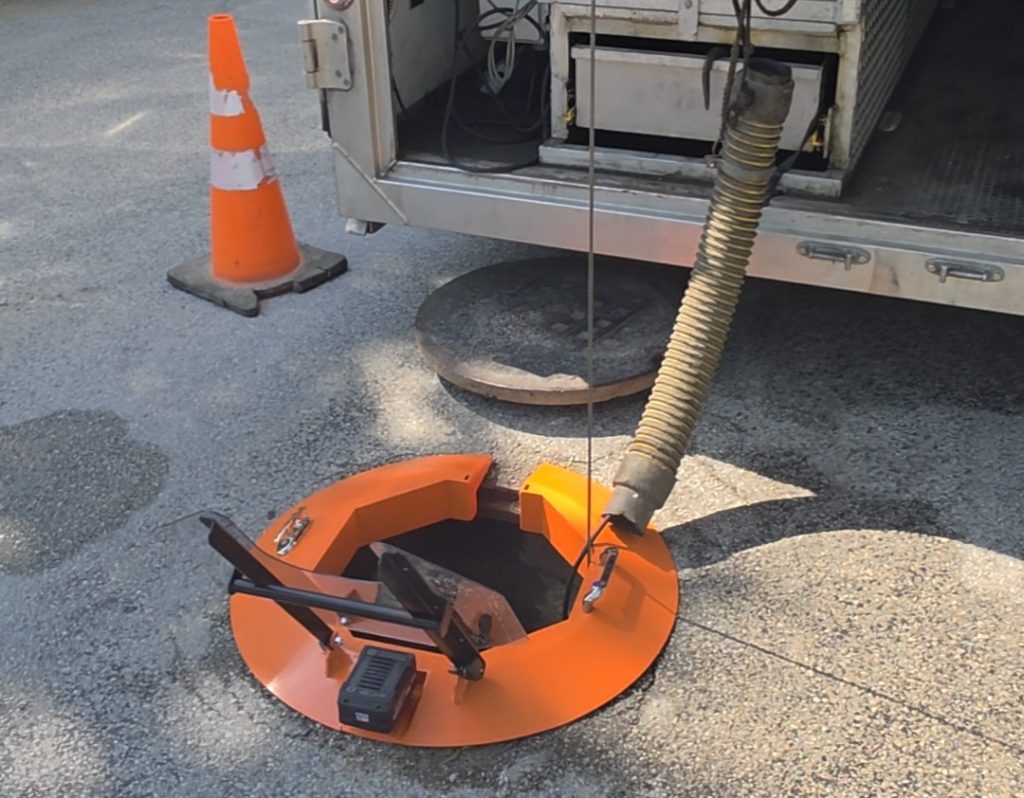
OSHA citations at manhole job sites rarely arrive one at a time. A single inspection that surfaces a fall protection violation typically surfaces a confined space violation, an illumination violation, and a General Duty Clause citation in the same report. With each serious violation carrying a five-figure penalty, the cost of getting OSHA manhole safety compliance wrong clears the cost of getting it right several times over.
The reason it happens is structural. OSHA standards relevant to manhole work are not consolidated in one place. They span confined space rules, fall protection requirements, illumination guidance, PPE standards, and the General Duty Clause. Most crews train on each standard in isolation, which works fine until a single job site activates four of them at once. A lot of crews think they are following protocol when they are actually missing specific requirements that apply every shift.
This guide breaks down what OSHA actually requires for manhole work, where the gray areas sit, and where engineering controls earn their keep against citations, claims, and worker injuries. It is written for public works directors, safety directors, and contractor ops managers who need a clear read on the standards without wading through CFR text.
A single manhole job site can activate six or more federal safety standards at once. That is what makes manhole work an OSHA compliance hot zone, and it is why citation reports from manhole-related incidents often surface three or four violations from a single inspection.
A crew opening a single manhole for a CCTV inspection or a jet truck cleaning operation may be subject to:
The stacking is why OSHA manhole safety conversations should not start at the equipment level. They should start with the standards and work back to what the equipment actually needs to support.
For Safety Directors and Public Works leadership, the practical takeaway is straightforward. Manhole work is not low risk just because it is routine. Compliance exposure on a manhole job site is denser than on most other field operations, which is why documented engineering controls carry weight in audits, insurance reviews, and budget approval cycles.
Yes, in nearly every case. OSHA defines a confined space as any space large enough for a worker to enter, with limited or restricted means of entry or exit, that is not designed for continuous occupancy. Manholes meet all three conditions by design.
Whether a specific manhole is a permit-required confined space depends on the hazards present. Under 29 CFR 1910.146 (general industry) and 29 CFR 1926 Subpart AA (construction), a confined space becomes permit-required when it contains or has the potential to contain:
Most sanitary sewer manholes meet at least one of these criteria because of atmospheric hazards alone. Hydrogen sulfide, methane, and oxygen deficiency are routinely documented in collection system structures, which means most municipal sewer manholes default to permit-required confined space status. Storm sewer, telecom, and electric vault manholes carry their own atmospheric and electrical hazard profiles that often qualify them as well.
The compliance implication is significant. Permit-required confined space entry triggers a written program, atmospheric testing before and during entry, attendant assignments, documented authorization for every entry, and a rescue plan with available rescue services. Crews that treat manholes as casual access points are often missing the rescue plan or the retrieval system entirely, which is one of the most commonly cited OSHA manhole safety gaps in real-world inspections.
OSHA requires fall protection at any unguarded hole or floor opening above a threshold height:
Manhole openings exceed both. The standards accept three forms of fall protection: a cover, a guardrail system, or a personal fall arrest system.
OSHA does not recognize traffic cones as fall protection at manhole openings. A plastic edge ring typically does not satisfy the structural barrier requirement either. That is the fall protection gap that manhole cover rings leave open.
For Safety Directors, the diagnostic question is direct: does the equipment at our open manholes meet the criteria in 1910.28(b)(3) or 1926.501(b)(4)? If the answer is “cones and a plastic ring,” it probably does not.
When fall protection citations stack with confined space and illumination citations, a single OSHA manhole safety issue becomes a five-figure assessment. The manhole opening is one of the highest-leverage places to deploy a real engineering control.
Yes, OSHA requires adequate lighting for manhole work and confined space entry. 29 CFR 1926.56 sets a minimum of 5 foot-candles for general construction areas, with higher requirements for specific work types and a separate requirement that lighting in wet or damp locations comply with 29 CFR 1910.305.
The practical question is whether the lighting on hand actually allows the work to be performed safely. Handheld flashlights and improvised setups rarely meet that bar. They do not consistently illuminate the work area, do not free operator hands, and do not eliminate the shadows where most contact incidents and alignment errors occur.
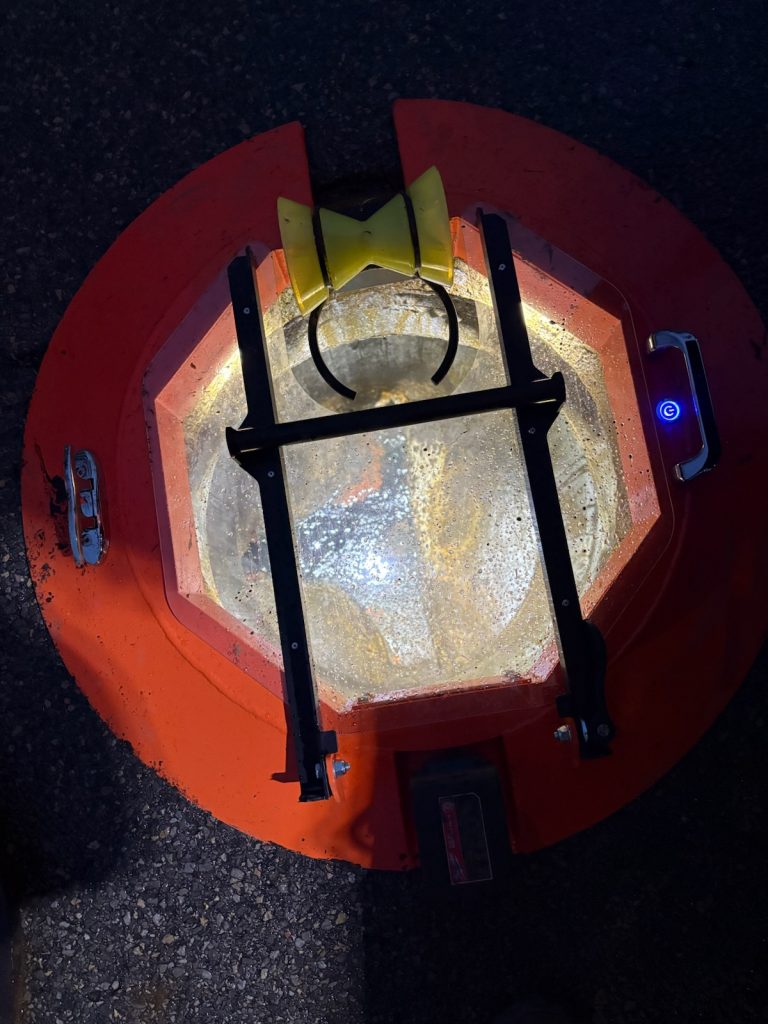
This is where hands-free, ring-mounted LED systems like the Light Ring close the gap. A 6,000-lumen ring at the opening distributes light radially across the work zone, eliminates shadow at the rim, and frees operator hands. Battery power eliminates the cord hazard entirely.
Crews working without consistent, hands-free illumination are exposed across multiple OSHA manhole safety categories at once, which is why lighting is one of the highest-impact engineering controls a Safety Director can deploy.
The OSHA hierarchy of controls ranks hazard prevention strategies from most to least effective. OSHA, NIOSH, and most insurers use it as the framework for evaluating compliance, designing safety programs, and prioritizing capital spending.
Applied to manhole work, the hierarchy looks like this:
| Level | Strategy | Manhole Work Example |
|---|---|---|
| 1 | Elimination – Remove the hazard | Trenchless repair methods that avoid manhole entry |
| 2 | Substitution – Replace with a less hazardous alternative | Pole-mounted cameras and robotic crawlers that reduce confined space entry |
| 3 | Engineering Controls – Physically separate the worker from the hazard | Structural barrier rings, integrated LED lighting, aerosol containment |
| 4 | Administrative Controls – Procedures, training, signage | Confined space entry permits, atmospheric testing protocols, traffic control plans |
| 5 | PPE – Protect the worker after exposure | Hard hats, gas monitors, harnesses, hi-visibility apparel |
The order matters because controls higher on the list reduce exposure more reliably than controls lower on the list, and because the hierarchy tells safety leadership where to direct capital. For OSHA manhole safety, most jobs cannot be eliminated or substituted, which makes engineering controls the highest-leverage layer available. Integrated systems like the Light Ring are designed to operate at that layer.
Most OSHA manhole safety violations do not show up in policy. They show up in field execution. The gaps below come up most often in citation reports and audit findings.
Cones define a perimeter. They do not satisfy the structural barrier requirement under OSHA fall protection standards. A worker stumbling toward an open manhole is not stopped by a cone.
A flashlight in one hand and equipment in the other is not consistent illumination of the work area. It also does not satisfy OSHA confined space lighting expectations, which assume the operator has hands free for the work itself.
Tiger tail ropes looped to truck bumpers or manhole covers often satisfy the immediate need but create trip hazards inside the work zone. These are the secondary exposures OSHA cites under the General Duty Clause even when no specific standard has been violated.
Permit-required confined space entry requires documented atmospheric testing, authorization, attendant assignments, and rescue planning. Crews that perform the work safely but do not generate the paperwork are in compliance gaps anyway.
The General Duty Clause under Section 5(a)(1) of the OSH Act is the catchall that lets OSHA cite recognized hazards even when no specific standard applies. It is also the standard most often cited when multiple specific standards have already been triggered at the same site. This is why integrated engineering controls earn their keep: they close multiple gaps with one piece of equipment.
Equipment that functions as an engineering control across multiple OSHA manhole safety categories at once reduces compliance exposure faster than single-purpose equipment can.
The Light Ring is built to operate this way:
Five gaps closed by one piece of equipment is what makes engineering controls the most defensible line item in a Safety Director’s budget.
Cost is the most common obstacle Safety Directors and Ops Managers report when evaluating engineering controls for manhole work. Three practical paths around the price tag:
Discretionary spending thresholds. Many municipalities operate with a discretionary spending threshold around $2,500 that does not require formal approval. Light Ring Inc. has worked with crews to fit projects inside that ceiling when there is a real operational need.
Rental program. Light Ring Inc. offers a one-week minimum rental at $250 per week, with up to $1,500 in rental fees credited toward purchase. The rental period also produces deployment documentation that strengthens the eventual capital request.
Safety grant funding. State OSHA programs, insurer-led safety funds, and industry associations offer workplace safety grants that often prioritize engineering controls. Light Ring Inc. supports applications with specs, performance data, and the documentation language reviewers expect.
If cost is the only thing standing between your crew and closing a real compliance gap, contact Light Ring Inc. directly. There is usually a path.
Yes, in nearly every case. Manholes meet OSHA’s three-part confined space definition (large enough to enter, limited entry and exit, not designed for continuous occupancy), and most sewer manholes also qualify as permit-required under 29 CFR 1910.146 due to atmospheric hazards including hydrogen sulfide, methane, and oxygen deficiency.
Yes. Under 29 CFR 1910.28 (general industry, 4-foot threshold) and 29 CFR 1926.501 (construction, 6-foot threshold), unguarded manhole openings require a cover, a guardrail system, or a personal fall arrest system.
No. OSHA does not recognize traffic cones as fall protection at manhole openings. Cones define a perimeter but do not satisfy the structural barrier requirement under 29 CFR 1910.28 or 1926.501.
OSHA’s 29 CFR 1926.56 sets a minimum of 5 foot-candles for general construction areas, with higher requirements for specific work types. Practical compliance generally requires consistent, hands-free illumination of the entire work area.
The hierarchy ranks hazard control strategies from most to least effective: elimination, substitution, engineering controls, administrative controls, and PPE. OSHA prioritizes engineering controls because they reduce exposure at the source rather than relying on PPE.
Yes. Citations at manhole sites often stack across confined space, fall protection, illumination, and General Duty Clause standards. Serious violations carry five-figure penalties each, and willful or repeat violations carry six-figure penalties.
Yes. Section 5(a)(1) of the OSH Act requires employers to furnish a workplace free from recognized hazards causing or likely to cause death or serious physical harm. The General Duty Clause is frequently cited at manhole sites when multiple specific standards have already been triggered, or when recognized hazards exist that no specific standard directly addresses.
Yes, in nearly every case. Manholes meet OSHA’s three-part confined space definition (large enough to enter, limited entry and exit, not designed for continuous occupancy), and most sewer manholes also qualify as permit-required under 29 CFR 1910.146 due to atmospheric hazards including hydrogen sulfide, methane, and oxygen deficiency.
Yes. Under 29 CFR 1910.28 (general industry, 4-foot threshold) and 29 CFR 1926.501 (construction, 6-foot threshold), unguarded manhole openings require a cover, a guardrail system, or a personal fall arrest system.
No. OSHA does not recognize traffic cones as fall protection at manhole openings. Cones define a perimeter but do not satisfy the structural barrier requirement under 29 CFR 1910.28 or 1926.501.
OSHA’s 29 CFR 1926.56 sets a minimum of 5 foot-candles for general construction areas, with higher requirements for specific work types. Practical compliance generally requires consistent, hands-free illumination of the entire work area.
The hierarchy ranks hazard control strategies from most to least effective: elimination, substitution, engineering controls, administrative controls, and PPE. OSHA prioritizes engineering controls because they reduce exposure at the source rather than relying on PPE.
Yes. Citations at manhole sites often stack across confined space, fall protection, illumination, and General Duty Clause standards. Serious violations carry five-figure penalties each, and willful or repeat violations carry six-figure penalties.
Yes. Section 5(a)(1) of the OSH Act requires employers to furnish a workplace free from recognized hazards causing or likely to cause death or serious physical harm. The General Duty Clause is frequently cited at manhole sites when multiple specific standards have already been triggered, or when recognized hazards exist that no specific standard directly addresses.
This guide is an overview, not legal counsel. Specific OSHA compliance obligations vary by jurisdiction, work type, and site conditions. Verify current requirements with your compliance officer and consult the latest CFR text directly when developing or auditing safety programs.
Closing the gap should not require five tools, three vendors, and a six-month budget cycle. The Light Ring is built to support OSHA compliance across confined space, fall protection, illumination, and electrical safety standards in a single deployable system. The lowest-friction next step is a one-week rental on an active job site.
Run it on your typical workflow, generate the deployment documentation a Safety Director needs for the capital request, and decide from there. Rental fees credit toward purchase up to $1,500.