
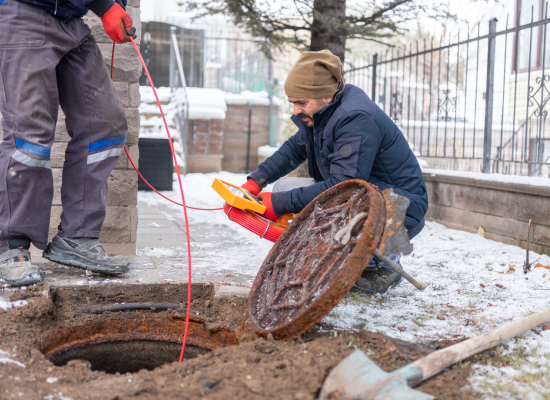
Manhole lighting plays a critical role in how crews work in cold weather, especially in regions that experience long, harsh winters. In cold Midwestern conditions, manhole work often takes place in environments that are wet, dark, and unpredictable. Snow, rain, and freezing temperatures affect visibility, footing, and equipment performance, increasing both safety risks and operational inefficiencies.
When cold outside air enters a warmer underground structure, condensation and fog quickly form inside the manhole. Cameras fog up, setup times increase, and crews lose valuable minutes during each deployment. These challenges are compounded during night work, emergency callouts, and operations in unlit areas, where reliable lighting becomes essential for maintaining control and reducing risk.
During a recent conversation with Shane Jacobson of Central Iowa Television, operator experience highlighted how modern manhole lighting and safety cover systems address these challenges in real-world conditions. The discussion focused on practical, operator-driven benefits observed in the field, not marketing claims. From reducing camera fog and limiting exposure to jetting spray to improving hands-free visibility in poor weather, proper lighting helps stabilize the work environment when conditions are far from ideal.
Understanding how manhole lighting performs in cold weather helps clarify its role beyond basic illumination. When lighting systems are designed for harsh environments, they support safer workflows, protect equipment, and help crews maintain productivity even during the most challenging conditions.
Cold weather creates one of the most persistent and frustrating challenges in manhole inspection and cleaning: fogged cameras. For crews performing CCTV inspections in winter, the issue is immediate and familiar. As soon as a camera is lowered into the manhole, visibility disappears behind condensation.
“In the wintertime, when you first put the camera into the pipe, it fogs up really bad,” said Shane Jacobson. “You’ve got to sit there and wait for it to go away.”
That waiting is not a minor inconvenience. In cold conditions, camera fogging can cost five to ten minutes per deployment, and the delay repeats throughout the day. Over the course of a shift, those minutes add up quickly, slowing progress and increasing frustration for crews already working in harsh conditions.
The cause is simple physics. Cold outside air rushing into a warmer underground environment creates condensation and steam. Before using a manhole safety cover, many crews relied on improvised solutions to manage the problem.
“We’d throw a moving blanket or winter coat over the manhole to keep that cold air from getting down in there,” Jacobson explained.
Modern manhole lighting and safety cover systems are designed to address this issue directly by limiting airflow and stabilizing conditions inside the structure. The Light Ring illuminated manhole protection system helps reduce the temperature differential at the opening, minimizing fogging on CCTV cameras and jet cams during cold weather operations. By maintaining clearer visibility from the start of each deployment, crews spend less time waiting and more time working.
Less waiting. More productivity. Fewer frustrations.
Cold weather does not just affect equipment. It affects the people operating it. During jetting and cleaning operations, mist and overspray rise from open manholes, exposing crews to moisture at a time when staying dry is already difficult in winter conditions.
In freezing temperatures, that exposure compounds quickly. Getting damp during a winter shift is uncomfortable, but the impact goes beyond discomfort. Wet clothing and cold air accelerate fatigue, reduce dexterity, and make it harder for operators to stay focused over long hours in the field. As Jacobson explained, “Getting covered in mist when it’s really cold out—it’s not something you enjoy.” Over the course of a shift, those conditions wear on crews, increasing frustration and narrowing the margin for safe decision-making during already demanding work.
Manhole lighting and safety cover systems that help contain spray at the source support safer cold weather operations by keeping crews drier and more comfortable. By reducing unnecessary exposure during jetting and inspection work, these systems help operators maintain focus, work more consistently, and complete winter jobs with fewer interruptions.
Emergency work does not wait for ideal conditions.
Rain events, night shifts, and unlit job sites are a normal part of collection system work, especially during winter months. In these environments, manhole lighting in cold weather becomes a critical safety control, not a convenience. Crews are often working on slick surfaces, managing heavy equipment, and responding under time pressure, all while visibility is limited.
When lighting is inconsistent or handheld, operators are forced to divide their attention. Holding a flashlight while guiding equipment into an open manhole reduces mobility and increases the risk of missteps or dropped tools. Hands-free manhole lighting helps stabilize these moments by illuminating the entire opening and surrounding work area, allowing crews to focus on safe deployment rather than juggling equipment.
In cold, wet, and low-light conditions, hands-free lighting supports safer operations by helping crews:
By removing the need to rely on handheld light sources, manhole lighting systems designed for cold weather help crews maintain control when conditions are stacked against them. In dark, wet, or chaotic environments, that stability matters.
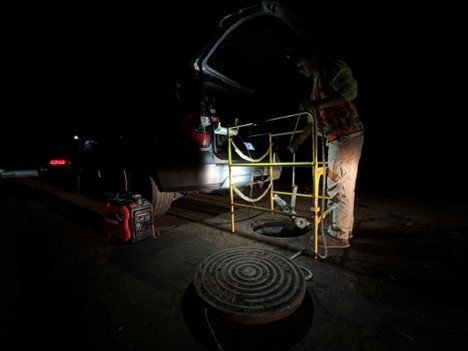
In many Midwest collection systems, drop connections are common. These configurations route the mainline into the manhole above the bench rather than at the bottom, often to manage grade changes, prevent freezing, or avoid excessive trench depth. While necessary, they introduce added complexity during inspection and cleaning work, especially when conditions are cold, wet, or poorly lit.
Properly aligning a camera tractor or jet nozzle into a drop connection requires clear visibility and precise control at the manhole opening. Without consistent lighting, operators are forced to rely on partial sightlines and experience to guide equipment into position. In winter conditions, reduced visibility and slick surfaces further increase the risk of misalignment, equipment contact with manhole walls, or sudden movement when high-pressure systems are engaged.
“Trying to get a tractor or jet nozzle into one of those drop connections can be really challenging,” said Jacobson. “If you don’t get the nozzle in there just right and you turn the jetter on, it could flop out and fly out and hit you.”
Consistent, well-positioned manhole lighting helps remove uncertainty at critical alignment points. By clearly illuminating the opening and surrounding work area, crews can position equipment more accurately, reduce trial and error, and lower injury risk when working with high-pressure tools.
Manholes are one of the most consistently hazardous work environments in collection systems. Crews regularly contend with confined spaces, limited visibility, heavy components, and unpredictable conditions that increase the likelihood of injury during routine operations.
A significant portion of collection system injuries can be traced back to manhole-related tasks, including:
These risks are compounded in cold weather, rain, and low-light conditions, when footing becomes less stable and visibility is reduced. Federal guidance on winter weather safety highlights the importance of addressing cold-related hazards as part of a comprehensive approach to worker protection. While no single tool eliminates every risk, improvements that enhance visibility and help stabilize the work environment play a meaningful role in reducing exposure and supporting safer operations.
Manhole lighting is often treated as a simple visibility upgrade. In real-world field conditions, that assumption falls apart quickly. When crews are working in cold, wet, and low-light environments, lighting becomes a factor in safety, workflow, and overall job performance.
As Shane Jacobson explained, “It goes back to the core function—hands-free lighting as a multi-use tool set that just makes your job easier.” That perspective reflects how operators experience lighting in the field. The value shows up not only in what crews can see, but in how confidently they can move through tasks without constantly adjusting equipment or compensating for poor conditions.
In cold weather operations, effective manhole lighting helps stabilize the work environment. It reduces camera fog caused by temperature changes, limits exposure to jetting spray, improves alignment at complex access points, and supports safer footing during rain events and night work. By addressing several challenges at once, lighting systems designed for real-world conditions contribute to safer, more consistent performance when conditions are far from ideal. For organizations evaluating safety improvements, tools that reduce risk and improve field performance may also qualify for funding through available workplace safety grants.
Cold weather, rain events, and low-light conditions are not edge cases in collection system work. They are the conditions crews routinely face. In these environments, manhole lighting in cold weather becomes more than a visibility aid. It influences how safely crews can move, how efficiently equipment is deployed, and how consistently work gets done when conditions are working against them.
Manhole lighting systems designed for real-world conditions help remove friction from some of the most challenging moments in the field. By supporting hands-free operation, stabilizing the work area, and maintaining reliable illumination in harsh environments, solutions like the Light Ring illuminated manhole protection system help crews work with greater confidence and control. To learn more about manhole lighting designed for cold weather operations, contact Light Ring to start the conversation.